
This post is a sequel to my earlier post Fourier Fun 2: The full monty, which derives the full expression for the one-dimensional Fourier series. If you have not read that post, you may wish to do so before reading this one.
Some practical applications
We have already examined the Fourier series for a number of periodic functions such as the square wave and the triangle wave, and for these waves the Fourier series is (more or less) exactly convergent. One might wonder whether the Fourier series could equally be applied to arbitrary functions. The answer is yes, but as we are expressing the function in terms of sines and cosines which are periodic, the series will only be particularly useful near to the point about which we are expanding. However, this is always the case when considering series expansions and so should not be cause for concern. Quite to the contrary, the Fourier series provides a powerful tool for approximating functions in terms of sines and/or cosines (which may render it much more amenable to analysis) by taking the truncated (finite) Fourier series about the point of interest. This is one of the tools of Fourier analysis, and is one very useful application of the Fourier series.Taking the the Fourier series of a function and looking at its components is often referred to as Fourier decomposition, and lies at the core of Fourier analysis. It is possible, however, to 'go the other way' and form a function by adding sines or cosines. This process is known as additive synthesis, and is often used, for example, in the context of music as the main principle behind electronic synthesisers. To explain, in music we can think of a note as being a sound with a pitch (a single sound frequency). But, for example, a middle C (C4) will sound different on a piano compared to a guitar. This is because every instrument produces a unique timbre (pronounced "tam-ber") that is determined by other additional frequencies mixed in with the fundamental frequency (the one with the largest amplitude which determines the note). Before we go on, let's take a slight diversion.
Complex exponential form
As a reminder, our "full" equation for the Fourier series in one dimension is given by
\begin{equation}
f(t)=\frac{a_0}{2}+\sum_{n=1}^{\infty}\Bigg(a_n\cos\left(\frac{2\pi nt}{T}\right)+b_n\sin\left(\frac{2\pi nt}{T}\right)\Bigg)
\end{equation}
where
\begin{align}
a_n&=\frac{2}{T}\int_{t_0}^{t_0+T}\! f(t)\cos\left(\frac{2\pi nt}{T}\right)\,\mathrm{d}t\\
b_n&=\frac{2}{T}\int_{t_0}^{t_0+T} \! f(t)\sin\left(\frac{2\pi nt}{T}\right)\,\mathrm{d}t
\end{align}
are known as the Fourier coefficients.
What we want to do now is use Euler's formula, one of the most famous formulas in all of mathematics (and rightly deserving of a post of its own). Euler's formula states that
\begin{equation}
\cos(\theta)+i\sin(\theta)=e^{i\theta}
\end{equation}
where $i$ is the imaginary unit (the number such that $i^2=-1$). For the purposes of this post we will simply take this formula for granted and leave its deeper mysteries for another time. Now, in Note 2 of the previous Fourier Fun post we showed that we can express the Fourier series in terms of complex exponentials thanks to Euler's formula. I will reproduce a condensed version of that demonstration here:
Let us define a set of terms $c_n$ in terms of the known Fourier coefficients $a_n$ and $b_n$ from the Fourier series formula:
\begin{equation*}
c_n=
\begin{cases}
\frac{1}{2}(a_n-ib_n) & \text{for } n > 0 \\
\frac{a_0}{2} & \text{for } n = 0 \\
\frac{1}{2}(a_n+ib_n) & \text{for } n < 0.
\end{cases}
\end{equation*}
Using these new $c_n$ coefficients, let's define an infinite summation
\begin{equation}
f(\theta)=\sum_{n=-\infty}^\infty c_n e^{in\theta}.
\end{equation}
We now break the sum into the three cases for $n$ (positive, zero and negative) and substitute in Euler's formula:
\begin{align*}
f(\theta)&=\sum_{n=-\infty}^{\infty}c_n e^{in\theta}\\
&=\sum_{n=1}^{\infty}c_{n} e^{in\theta}+c_0 e^0+\sum_{n=-\infty}^{-1}c_{n} e^{in\theta}\\
&=\sum_{n=1}^{\infty}c_{+n} e^{+in\theta}+c_0+\sum_{n=1}^{\infty}c_{-n} e^{-in\theta}\\
&=\frac{a_0}{2}+\sum_{n=1}^{\infty}\left(\frac{1}{2}(a_n-ib_n)\big(\cos(n\theta)+i\sin(n\theta)\big)\right.\\
&\qquad \left.+\frac{1}{2}(a_{-n}-ib_{-n})\big(\cos(-n\theta)+i\sin(-n\theta)\big)\right)\\
&=\frac{a_0}{2}+\sum_{n=1}^{\infty}\left(\frac{1}{2}(a_n-ib_n)\big(\cos(n\theta)+i\sin(n\theta)\big)\right.\\
&\qquad \left.+\frac{1}{2}(a_n+ib_n)\big(\cos(n\theta)-i\sin(n\theta)\big)\right)\\
&=\frac{a_0}{2}+\sum_{n=1}^{\infty}\big(a_n\cos(n\theta)+b_n\sin(n\theta)\big),
\end{align*}
where in the third line we have made the change of index $n\mapsto -n$ in the last sum (note that this means that in order for $-n$ to be negative-valued, $n$ must now be positive-valued) and exploited in going from the fourth to the fifth line the facts that $\cos(-\theta)=\cos(\theta)$ and $\sin(-\theta)=-\sin(\theta)$ and therefore $a_{-n}=a_n$ and $b_{-n}=b_n$. Thus we have demonstrated the equivalence of our previously known Fourier series formula with the infinite sum in equation 5.
This explanation is poor in the sense that it is not well motivated (it would be much more satisfying to go the other way, from our known Fourier series formula deriving the complex exponential form) but for our purposes demonstrating the equivalence will be sufficient for the next section.
\begin{equation}
f(t)=\frac{a_0}{2}+\sum_{n=1}^{\infty}\Bigg(a_n\cos\left(\frac{2\pi nt}{T}\right)+b_n\sin\left(\frac{2\pi nt}{T}\right)\Bigg)
\end{equation}
where
\begin{align}
a_n&=\frac{2}{T}\int_{t_0}^{t_0+T}\! f(t)\cos\left(\frac{2\pi nt}{T}\right)\,\mathrm{d}t\\
b_n&=\frac{2}{T}\int_{t_0}^{t_0+T} \! f(t)\sin\left(\frac{2\pi nt}{T}\right)\,\mathrm{d}t
\end{align}
are known as the Fourier coefficients.
What we want to do now is use Euler's formula, one of the most famous formulas in all of mathematics (and rightly deserving of a post of its own). Euler's formula states that
\begin{equation}
\cos(\theta)+i\sin(\theta)=e^{i\theta}
\end{equation}
where $i$ is the imaginary unit (the number such that $i^2=-1$). For the purposes of this post we will simply take this formula for granted and leave its deeper mysteries for another time. Now, in Note 2 of the previous Fourier Fun post we showed that we can express the Fourier series in terms of complex exponentials thanks to Euler's formula. I will reproduce a condensed version of that demonstration here:
Let us define a set of terms $c_n$ in terms of the known Fourier coefficients $a_n$ and $b_n$ from the Fourier series formula:
\begin{equation*}
c_n=
\begin{cases}
\frac{1}{2}(a_n-ib_n) & \text{for } n > 0 \\
\frac{a_0}{2} & \text{for } n = 0 \\
\frac{1}{2}(a_n+ib_n) & \text{for } n < 0.
\end{cases}
\end{equation*}
Using these new $c_n$ coefficients, let's define an infinite summation
\begin{equation}
f(\theta)=\sum_{n=-\infty}^\infty c_n e^{in\theta}.
\end{equation}
We now break the sum into the three cases for $n$ (positive, zero and negative) and substitute in Euler's formula:
\begin{align*}
f(\theta)&=\sum_{n=-\infty}^{\infty}c_n e^{in\theta}\\
&=\sum_{n=1}^{\infty}c_{n} e^{in\theta}+c_0 e^0+\sum_{n=-\infty}^{-1}c_{n} e^{in\theta}\\
&=\sum_{n=1}^{\infty}c_{+n} e^{+in\theta}+c_0+\sum_{n=1}^{\infty}c_{-n} e^{-in\theta}\\
&=\frac{a_0}{2}+\sum_{n=1}^{\infty}\left(\frac{1}{2}(a_n-ib_n)\big(\cos(n\theta)+i\sin(n\theta)\big)\right.\\
&\qquad \left.+\frac{1}{2}(a_{-n}-ib_{-n})\big(\cos(-n\theta)+i\sin(-n\theta)\big)\right)\\
&=\frac{a_0}{2}+\sum_{n=1}^{\infty}\left(\frac{1}{2}(a_n-ib_n)\big(\cos(n\theta)+i\sin(n\theta)\big)\right.\\
&\qquad \left.+\frac{1}{2}(a_n+ib_n)\big(\cos(n\theta)-i\sin(n\theta)\big)\right)\\
&=\frac{a_0}{2}+\sum_{n=1}^{\infty}\big(a_n\cos(n\theta)+b_n\sin(n\theta)\big),
\end{align*}
where in the third line we have made the change of index $n\mapsto -n$ in the last sum (note that this means that in order for $-n$ to be negative-valued, $n$ must now be positive-valued) and exploited in going from the fourth to the fifth line the facts that $\cos(-\theta)=\cos(\theta)$ and $\sin(-\theta)=-\sin(\theta)$ and therefore $a_{-n}=a_n$ and $b_{-n}=b_n$. Thus we have demonstrated the equivalence of our previously known Fourier series formula with the infinite sum in equation 5.
This explanation is poor in the sense that it is not well motivated (it would be much more satisfying to go the other way, from our known Fourier series formula deriving the complex exponential form) but for our purposes demonstrating the equivalence will be sufficient for the next section.
Fourier transforms
We will now introduce the (unitary, temporal frequency) Fourier transform:
\begin{equation}
\tilde{f}(\nu)=\int_{-\infty}^\infty\! f(t)e^{-2\pi it\nu}\,\mathrm{d}t
\end{equation}
\tilde{f}(\nu)=\int_{-\infty}^\infty\! f(t)e^{-2\pi it\nu}\,\mathrm{d}t
\end{equation}
where if $t$ is time then $\nu$ is frequency and the inverse Fourier transform is given by
\begin{equation}
f(t)=\int_{-\infty}^\infty\! \tilde{f}(\nu)e^{+2\pi it\nu}\,\mathrm{d}\nu.
\end{equation}
f(t)=\int_{-\infty}^\infty\! \tilde{f}(\nu)e^{+2\pi it\nu}\,\mathrm{d}\nu.
\end{equation}
The fact that this particular integral transform is named after Fourier should provide a hint that it is related to Fourier analysis, and in fact it is a central part of it. We can demonstrate this relationship by finding the Fourier transform of a function which is expressed in terms of its Fourier series, which is easiest to compute when we use the complex exponential form.$^1$ This will give
\begin{align}
\tilde{f}(\nu)&=\int_{-\infty}^\infty\! f(t)e^{-2\pi i t \nu}\,\mathrm{d}t\nonumber\\
&=\int_{-\infty}^\infty\!\sum_{n=-\infty}^\infty c_n e^{2\pi int/T}e^{-2\pi i t \nu}\,\mathrm{d}t\nonumber\\
&=\sum_{n=-\infty}^\infty\left(c_n\int_{-\infty}^\infty\! e^{2\pi it(n/T-\nu)}\,\mathrm{d}t\right)\nonumber\\
&=\sum_{n=-\infty}^\infty c_n\delta\left(\frac{n}{T}-\nu\right)
\end{align}
where in going to the final line we have used the definition of Dirac delta functional $\delta(a-\xi)=\int_{-\infty}^\infty \! e^{2\pi ix(a-\xi)}\,\mathrm{d}x$. This final line might look a bit odd, but we can easily make sense of it. The Dirac delta $\delta(a-\xi)$ is defined (simply speaking) as a 'spike' of infinitessimal width and infinite height located at $\xi=a$, so what equation 8 is saying is that the Fourier transform of a periodic function's Fourier series is an infinite number of Dirac deltas located at $\nu=n/T$ for all integers $n$, each one 'weighted'$^2$ by its corresponding Fourier coefficient $c_n$. This is quite a result -- as the Fourier transform automatically gives us the Fourier coefficients of the original function and their corresponding frequencies, it allows us to perform a decomposition on any periodic function (see Fig. 1 for an intuitive visualisation).
\tilde{f}(\nu)&=\int_{-\infty}^\infty\! f(t)e^{-2\pi i t \nu}\,\mathrm{d}t\nonumber\\
&=\int_{-\infty}^\infty\!\sum_{n=-\infty}^\infty c_n e^{2\pi int/T}e^{-2\pi i t \nu}\,\mathrm{d}t\nonumber\\
&=\sum_{n=-\infty}^\infty\left(c_n\int_{-\infty}^\infty\! e^{2\pi it(n/T-\nu)}\,\mathrm{d}t\right)\nonumber\\
&=\sum_{n=-\infty}^\infty c_n\delta\left(\frac{n}{T}-\nu\right)
\end{align}
where in going to the final line we have used the definition of Dirac delta functional $\delta(a-\xi)=\int_{-\infty}^\infty \! e^{2\pi ix(a-\xi)}\,\mathrm{d}x$. This final line might look a bit odd, but we can easily make sense of it. The Dirac delta $\delta(a-\xi)$ is defined (simply speaking) as a 'spike' of infinitessimal width and infinite height located at $\xi=a$, so what equation 8 is saying is that the Fourier transform of a periodic function's Fourier series is an infinite number of Dirac deltas located at $\nu=n/T$ for all integers $n$, each one 'weighted'$^2$ by its corresponding Fourier coefficient $c_n$. This is quite a result -- as the Fourier transform automatically gives us the Fourier coefficients of the original function and their corresponding frequencies, it allows us to perform a decomposition on any periodic function (see Fig. 1 for an intuitive visualisation).
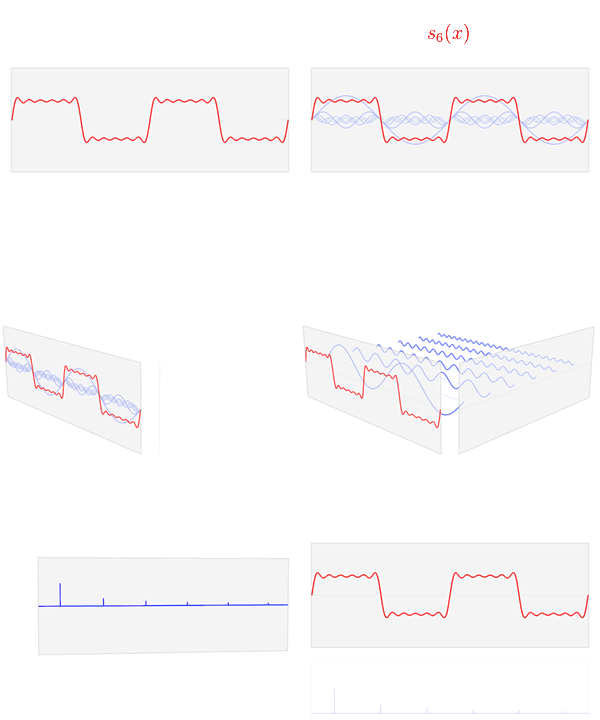 |
| Figure 1: A graphical representation of the first 6 terms of the Fourier series for the square wave in the time domain, here denoted by $s_6(t)$, and its Fourier transform in the frequency domain, denoted by $S(f)$. Note that, as per equation 8 and subsequent discussion, is the Fourier series is expressed in terms of sine functions, the frequency axis for $S(f)$ will be imaginary. Consider this figure with Note 2 in mind. [1] |
Now let's consider a simple string that is held taut at both ends and plucked exactly in the middle. The vibrating string will support a standing wave with a wavelength given by twice the length of the string, such that there are nodes (points of zero amplitude) at the ends and an antinode (point of maximal amplitude) in the centre. However, in principle it could also support standing waves with odd multiples of frequency (such as those with three antinodes, or five, and so on -- odd-numbered so that there is always an antinode in the centre) or a superposition (or sum) of these waves.$^3$ If this is sounding familiar, it certainly should, because the initial state of such a plucked string, when the centre of the string is pulled away but before it is released, is of course triangular, and the Fourier series of a triangle wave is given by a weighted sum of sine waves with frequencies that are odd multiples of the fundamental frequency.
As sound is merely displaced air, the sound produced by the vibrating string will match (approximately) the vibration on the string itself. Thus, if we take the Fourier transform of the sound produced by the string when it is just released and the string is retaining its triangular shape (before it loses energy due to heat dissipation and air resistance) we will find the Fourier coefficients for a triangular wave! In this context, the Fourier components of the triangle wave have a physical and musical significance, as harmonics of the fundamental frequency (the frequency of the overall note). Furthermore, if we take Fourier transforms at later times, as the vibration in the string 'decays', we can see how the Fourier composition of the sound changes with time. The way the composition/vibration changes with time (even over the course of only a second) has a huge impact on the timbre of the string. As an example, consider two strings of equal length, plucked in the exact same way, but made of different materials. We know they will sound different, albeit similar, despite their initial shape being identical.
As sound is merely displaced air, the sound produced by the vibrating string will match (approximately) the vibration on the string itself. Thus, if we take the Fourier transform of the sound produced by the string when it is just released and the string is retaining its triangular shape (before it loses energy due to heat dissipation and air resistance) we will find the Fourier coefficients for a triangular wave! In this context, the Fourier components of the triangle wave have a physical and musical significance, as harmonics of the fundamental frequency (the frequency of the overall note). Furthermore, if we take Fourier transforms at later times, as the vibration in the string 'decays', we can see how the Fourier composition of the sound changes with time. The way the composition/vibration changes with time (even over the course of only a second) has a huge impact on the timbre of the string. As an example, consider two strings of equal length, plucked in the exact same way, but made of different materials. We know they will sound different, albeit similar, despite their initial shape being identical.
If we have a machine which can produce 'overlapping' single-frequency tones, we can play those harmonic frequencies at the appropriate relative amplitudes and thus reproduce the sound of the string at any given time. Do this for a range of times, changing the components over time to match the Fourier decomposition we found for the decaying note, and now you can (re)create the sound of the string being plucked without any string required! Or, if you want to be creative, change all the frequencies and thus the note being played or change only some of the frequencies or change the relative amplitudes to change the timbre altogether. This is additive synthesis in action, and electronic synthesisers work on this principle.$^4$
Double-slit diffraction
Fourier transforms in particular can be found all over physics, much more so than Fourier series. One sub-field which makes considerable use of them is in the application of Fourier analysis to wave optics, which is often referred to as Fourier optics. One example I particularly like is regarding diffraction in the far-field (Fraunhofer) regime,$^5$ where we are looking at the intensity profile of light at a large distance from the aperture(s). We will assume that the light is incident on the aperture(s) at a right angle and is also monochromatic (of a single wavelength/frequency). As a matter of terminology, I will refer to the diffraction pattern as being visualised on a screen parallel to the plane of the aperture.
In this case, the amplitude profile of the diffracted light (when we are using Cartesian coordinates) is proportional to the Fourier transform of the amplitude at the aperture. But wait, in previous examples we discussed taking Fourier transforms of functions of time $t$. These resulted in functions of frequency $\nu$, which has units inverse to time. Surely if we take the Fourier transform of a function of distance $x$ (as our aperture amplitude is of course a distribution over space and not time!) we should end up with a function of spatial frequency $\xi$?$^6$ This would have units of inverse distance, but the diffraction pattern amplitude is also distributed over space on the screen, not some "inverse space"! How do we reconcile these ideas?
In this case, spatial frequency has no physical meaning, and this method of using the Fourier transform is just a mathematical tool. So we can choose to define the frequency however we want (so long as we are consistent). We choose to define the spatial frequency as $\xi=x'/\lambda L$ where $x'$ is the usual coordinate distance along the diffraction pattern (we would call it $x$ except we're already using that as the spatial coordinate for the aperture function), $\lambda$ is the wavelength of the light and $L$ is the distance from the aperture to the screen. Checking the dimensions, we see that $\xi$ still has dimensions of inverse distance (since $x'$, $\lambda$ and $L$ all have units of distance) but now we can everywhere substitute $x'/\lambda L$ for $\xi$, and since $\lambda$ and $L$ are both constants, our function of spatial frequency has just become a function of (scaled) $x'$, just as we wanted!
So now we have a way to find our diffraction pattern $U(x')$ from our aperture function $A(x)$:
\begin{equation}
U(x')\propto\int_{-\infty}^\infty \! A(x)e^{-2\pi ixx'/\lambda L}\,\mathrm{d}x
\end{equation}
or, equivalently, $U(x')\propto\tilde{A}(x'/\lambda L)$. To make this more concrete, let's do some examples (these examples will be one-dimensional only, so neglect patterns across the whole plane of the screen -- this is not possible in practice, although for appropriately chosen sources and apertures it is a very good approximation). First, we'll consider a single slit of finite width. This can be represented by the rectangular function $\mathrm{rect}(x/W)$ which is $0$ everywhere except between $x=\pm W/2$, where it is equal to $1$ (clearly here $W$ represents the width of the non-zero part of the function).$^7$ This means that our Fourier transform becomes
\begin{align}
U(x')&\propto\int_{-\infty}^\infty \! \mathrm{rect}\left(\frac{x}{W}\right)e^{-2\pi ixx'/\lambda L}\,\mathrm{d}x=\int_{-W/2}^{W/2}\! e^{-2\pi ixx'/\lambda L}\,\mathrm{d}x\nonumber\\
&\propto\left[\frac{\lambda L}{2\pi ix'}e^{-2\pi ixx'/\lambda L}\right]_{-W/2}^{+W/2}\nonumber\\
&\propto\frac{\lambda L}{2\pi ix'}\left(e^{+\pi iWx'/\lambda L}-e^{-\pi iWx'/\lambda L}\right)\nonumber\\
&\propto\frac{\lambda L}{\pi x'}\sin\left(\frac{\pi Wx'}{\lambda L}\right)=W\mathrm{sinc}\left(\frac{\pi Wx'}{\lambda L}\right)\\
\Rightarrow U(\theta)&\propto W\mathrm{sinc}\left(\frac{\pi W}{\lambda}\sin(\theta)\right).
\end{align}
In the fourth line we have made use of the identity (following immediately from Euler's formula) $\sin(x)=(e^{ix}-e^{-ix})/2i$ and the definition $\mathrm{sinc}(x):=\sin(x)/x$. In the final line we have made use of the small angle approximation to put the diffraction pattern amplitude in terms of $\theta$ instead of $x'$, which is more common.$^8$ Finally, what we are really interested in is not the amplitude but rather the (observable) intensity profile at the screen, which is simply the square of the amplitude, and thus we find
\begin{align}
I(x')&\propto \mathrm{sinc}^2\left(\frac{\pi Wx'}{\lambda L}\right),\\
I(\theta)&\propto \mathrm{sinc}^2\left(\frac{\pi W}{\lambda}\sin(\theta)\right).
\end{align}
This is, up to a scalar factor, exactly the intensity distribution we observe for single-slit diffraction (Fig. 2)!
Now let's try something a bit more interesting. What about two slits? First, we'll consider two slits of infinitesimal width located at $x=\pm d/2$ such that the slits are separated by a distance $d$. This gives an aperture function of $A(x)=\delta(x-d/2)+\delta(x+d/2)$.
\begin{align}
U(x')&\propto\int_{-\infty}^\infty\! \delta\left(x-\frac{d}{2}\right)e^{-2\pi ixx'/\lambda L}\,\mathrm{d}x+\int_{-\infty}^\infty\! \delta\left(x+\frac{d}{2}\right)e^{-2\pi ixx'/\lambda L}\,\mathrm{d}x\nonumber\\
&\propto e^{-\pi idx'/\lambda L}+e^{+\pi idx'/\lambda L}\nonumber\\
&\propto 2\cos\left(\frac{\pi dx'}{\lambda L}\right).
\end{align}
In the second line we have exploited the sifting property of the Dirac delta, $\int_{-\infty}^\infty\!\delta(x-a)f(x)\mathrm{d}x=f(a)$ and in the third line used the identity $\cos(x)=(e^{ix}+e^{-ix})/2$ which, as for the sine case above, also immediately follows from Euler's formula. Therefore, we find an intensity profile of
\begin{align}
I(x')&\propto\cos^2\left(\frac{\pi dx'}{\lambda L}\right),\\
I(\theta)&\propto\cos^2\left(\frac{\pi d}{\lambda}\sin(\theta)\right).
\end{align}
which is again what we expect for "ideal" double-slit interference. In reality, however, not too far from $x'=\theta=0$ one observes unexpected dark regions, which is not what this $\cos^2$ profile suggests. What might be the cause of this discrepancy?
If you guessed the fact that we are using infinitesimal slits, that's a pretty good guess! Let's now go through the same derivation, but with two finite slits as in the single-slit example. Before going on, have a think about what you expect the final function to be first!
\begin{align}
U(x')&\propto\int_{-\infty}^\infty\! \Bigg(\mathrm{rect}\left(\frac{x-d/2}{W}\right)+\mathrm{rect}\left(\frac{x+d/2}{W}\right)\Bigg)e^{-2\pi ixx'/\lambda L}\,\mathrm{d}x\nonumber\\
&\propto\left[\frac{\lambda L}{2\pi ix'}e^{-2\pi ixx'/\lambda L}\right]_{(d-W)/2}^{(d+W)/2}+\left[\frac{\lambda L}{2\pi ix'}e^{-2\pi ixx'/\lambda L}\right]_{(-d+W)/2}^{(-d-W)/2}\nonumber\\
&\propto\frac{\lambda L}{2\pi ix'}\left( e^{-\pi i(d+W)x'/\lambda L}-e^{-\pi i(d-W)x'/\lambda L}+e^{-\pi i(-d+W)x'/\lambda L}\right.\nonumber\\
&\qquad \left.-e^{-\pi i(-d-W)x'/\lambda L} \right)\nonumber\\
&\propto\frac{-\lambda L}{2\pi ix'}\left(e^{+\pi idx'/\lambda L}+e^{-\pi idx'/\lambda L}\right)\left(e^{+\pi iWx'/\lambda L}-e^{-\pi iWx'/\lambda L}\right)\nonumber\\
&\propto-2W\cos\left(\frac{\pi dx'}{\lambda L}\right)\mathrm{sinc}\left(\frac{\pi Wx'}{\lambda L}\right),
\end{align}
and so our intensity is
\begin{align}
I(x')&\propto\cos^2\left(\frac{\pi dx'}{\lambda L}\right)\mathrm{sinc}^2\left(\frac{\pi Wx'}{\lambda L}\right),\\
I(\theta)&\propto\cos^2\left(\frac{\pi d}{\lambda }\sin(\theta)\right)\mathrm{sinc}^2\left(\frac{\pi W}{\lambda}\sin(\theta)\right).
\end{align}
This is just the infinitesimal double-slit intensity profile with the envelope of the single-slit intensity profile, which is exactly what we observe when we perform the experiment (Fig. 3)! Now, it is possible to use this and other related methods to find the intensity profiles for any arbitrary aperture, but I hope that from these few examples you already appreciate the power of this technique. I am sure that those readers who have derived these expressions through more direct (and convoluted) wave phase and trigonometric arguments certainly will!
In this case, spatial frequency has no physical meaning, and this method of using the Fourier transform is just a mathematical tool. So we can choose to define the frequency however we want (so long as we are consistent). We choose to define the spatial frequency as $\xi=x'/\lambda L$ where $x'$ is the usual coordinate distance along the diffraction pattern (we would call it $x$ except we're already using that as the spatial coordinate for the aperture function), $\lambda$ is the wavelength of the light and $L$ is the distance from the aperture to the screen. Checking the dimensions, we see that $\xi$ still has dimensions of inverse distance (since $x'$, $\lambda$ and $L$ all have units of distance) but now we can everywhere substitute $x'/\lambda L$ for $\xi$, and since $\lambda$ and $L$ are both constants, our function of spatial frequency has just become a function of (scaled) $x'$, just as we wanted!
So now we have a way to find our diffraction pattern $U(x')$ from our aperture function $A(x)$:
\begin{equation}
U(x')\propto\int_{-\infty}^\infty \! A(x)e^{-2\pi ixx'/\lambda L}\,\mathrm{d}x
\end{equation}
or, equivalently, $U(x')\propto\tilde{A}(x'/\lambda L)$. To make this more concrete, let's do some examples (these examples will be one-dimensional only, so neglect patterns across the whole plane of the screen -- this is not possible in practice, although for appropriately chosen sources and apertures it is a very good approximation). First, we'll consider a single slit of finite width. This can be represented by the rectangular function $\mathrm{rect}(x/W)$ which is $0$ everywhere except between $x=\pm W/2$, where it is equal to $1$ (clearly here $W$ represents the width of the non-zero part of the function).$^7$ This means that our Fourier transform becomes
\begin{align}
U(x')&\propto\int_{-\infty}^\infty \! \mathrm{rect}\left(\frac{x}{W}\right)e^{-2\pi ixx'/\lambda L}\,\mathrm{d}x=\int_{-W/2}^{W/2}\! e^{-2\pi ixx'/\lambda L}\,\mathrm{d}x\nonumber\\
&\propto\left[\frac{\lambda L}{2\pi ix'}e^{-2\pi ixx'/\lambda L}\right]_{-W/2}^{+W/2}\nonumber\\
&\propto\frac{\lambda L}{2\pi ix'}\left(e^{+\pi iWx'/\lambda L}-e^{-\pi iWx'/\lambda L}\right)\nonumber\\
&\propto\frac{\lambda L}{\pi x'}\sin\left(\frac{\pi Wx'}{\lambda L}\right)=W\mathrm{sinc}\left(\frac{\pi Wx'}{\lambda L}\right)\\
\Rightarrow U(\theta)&\propto W\mathrm{sinc}\left(\frac{\pi W}{\lambda}\sin(\theta)\right).
\end{align}
In the fourth line we have made use of the identity (following immediately from Euler's formula) $\sin(x)=(e^{ix}-e^{-ix})/2i$ and the definition $\mathrm{sinc}(x):=\sin(x)/x$. In the final line we have made use of the small angle approximation to put the diffraction pattern amplitude in terms of $\theta$ instead of $x'$, which is more common.$^8$ Finally, what we are really interested in is not the amplitude but rather the (observable) intensity profile at the screen, which is simply the square of the amplitude, and thus we find
\begin{align}
I(x')&\propto \mathrm{sinc}^2\left(\frac{\pi Wx'}{\lambda L}\right),\\
I(\theta)&\propto \mathrm{sinc}^2\left(\frac{\pi W}{\lambda}\sin(\theta)\right).
\end{align}
This is, up to a scalar factor, exactly the intensity distribution we observe for single-slit diffraction (Fig. 2)!
 |
| Figure 2:Finite-width single-slit diffraction intensity profile $I(x')$ superposed above an experimental single-slit diffraction pattern for illustrative purposes. As the experimental parameters were not known, the units shown are arbitrary. Adapted from [2] |
\begin{align}
U(x')&\propto\int_{-\infty}^\infty\! \delta\left(x-\frac{d}{2}\right)e^{-2\pi ixx'/\lambda L}\,\mathrm{d}x+\int_{-\infty}^\infty\! \delta\left(x+\frac{d}{2}\right)e^{-2\pi ixx'/\lambda L}\,\mathrm{d}x\nonumber\\
&\propto e^{-\pi idx'/\lambda L}+e^{+\pi idx'/\lambda L}\nonumber\\
&\propto 2\cos\left(\frac{\pi dx'}{\lambda L}\right).
\end{align}
In the second line we have exploited the sifting property of the Dirac delta, $\int_{-\infty}^\infty\!\delta(x-a)f(x)\mathrm{d}x=f(a)$ and in the third line used the identity $\cos(x)=(e^{ix}+e^{-ix})/2$ which, as for the sine case above, also immediately follows from Euler's formula. Therefore, we find an intensity profile of
\begin{align}
I(x')&\propto\cos^2\left(\frac{\pi dx'}{\lambda L}\right),\\
I(\theta)&\propto\cos^2\left(\frac{\pi d}{\lambda}\sin(\theta)\right).
\end{align}
which is again what we expect for "ideal" double-slit interference. In reality, however, not too far from $x'=\theta=0$ one observes unexpected dark regions, which is not what this $\cos^2$ profile suggests. What might be the cause of this discrepancy?
If you guessed the fact that we are using infinitesimal slits, that's a pretty good guess! Let's now go through the same derivation, but with two finite slits as in the single-slit example. Before going on, have a think about what you expect the final function to be first!
\begin{align}
U(x')&\propto\int_{-\infty}^\infty\! \Bigg(\mathrm{rect}\left(\frac{x-d/2}{W}\right)+\mathrm{rect}\left(\frac{x+d/2}{W}\right)\Bigg)e^{-2\pi ixx'/\lambda L}\,\mathrm{d}x\nonumber\\
&\propto\left[\frac{\lambda L}{2\pi ix'}e^{-2\pi ixx'/\lambda L}\right]_{(d-W)/2}^{(d+W)/2}+\left[\frac{\lambda L}{2\pi ix'}e^{-2\pi ixx'/\lambda L}\right]_{(-d+W)/2}^{(-d-W)/2}\nonumber\\
&\propto\frac{\lambda L}{2\pi ix'}\left( e^{-\pi i(d+W)x'/\lambda L}-e^{-\pi i(d-W)x'/\lambda L}+e^{-\pi i(-d+W)x'/\lambda L}\right.\nonumber\\
&\qquad \left.-e^{-\pi i(-d-W)x'/\lambda L} \right)\nonumber\\
&\propto\frac{-\lambda L}{2\pi ix'}\left(e^{+\pi idx'/\lambda L}+e^{-\pi idx'/\lambda L}\right)\left(e^{+\pi iWx'/\lambda L}-e^{-\pi iWx'/\lambda L}\right)\nonumber\\
&\propto-2W\cos\left(\frac{\pi dx'}{\lambda L}\right)\mathrm{sinc}\left(\frac{\pi Wx'}{\lambda L}\right),
\end{align}
and so our intensity is
\begin{align}
I(x')&\propto\cos^2\left(\frac{\pi dx'}{\lambda L}\right)\mathrm{sinc}^2\left(\frac{\pi Wx'}{\lambda L}\right),\\
I(\theta)&\propto\cos^2\left(\frac{\pi d}{\lambda }\sin(\theta)\right)\mathrm{sinc}^2\left(\frac{\pi W}{\lambda}\sin(\theta)\right).
\end{align}
This is just the infinitesimal double-slit intensity profile with the envelope of the single-slit intensity profile, which is exactly what we observe when we perform the experiment (Fig. 3)! Now, it is possible to use this and other related methods to find the intensity profiles for any arbitrary aperture, but I hope that from these few examples you already appreciate the power of this technique. I am sure that those readers who have derived these expressions through more direct (and convoluted) wave phase and trigonometric arguments certainly will!
 |
| Figure 3: Finite-width double-slit diffraction intensity profile $I(x')$ superposed above an experimental double-slit diffraction pattern for illustrative purposes. As the experimental parameters were not known, the units shown are arbitrary. We have chosen $d=7W$ to approximately match the image. Adapted from [2]. |
Conclusion
This is the final post of my 3-part Fourier Fun series, a crash-course introduction to Fourier analysis. In it we have covered the basics of the Fourier series and Fourier transform, hopefully to the point where the reader has a little be of intuitive understanding of where they come from, how they work (and why) and, with a little practice, will be able to make use of them in calculations. I want to stress, however, that I have only scratched the surface in these posts. In physics alone, the Fourier transform in particular is almost ubiquitous and its uses and subtleties are great in number. Even if the reader is unlikely to encounter it in their day-to-day life, I have no doubt that we will see it crop up time and again on the blog. When I first learnt about the Fourier transform, and didn't particularly understand it well, that thought would have horrified me! I hope that is not the case for the reader, but even if so, take solace in the fact that a good couple of years of learning how to tame Fourier transforms, now I wouldn't know what to do without them -- so it goes with many things! I hope you've enjoyed the series, the next blog post should be coming up in the next week or two, so keep an eye out!
Notes
$1$. Something may be jumping out at you here -- the complex exponential form of the Fourier series may be equivalent to the sine+cosine version we are used to, but what about only a single component? Won't the Fourier transform of $e^{i\xi}=\cos (\xi)+i\sin(\xi)$ be different to, for example, $\cos (\xi)$ by itself? The answer is yes. The Fourier transform of $\cos (\xi)$ is given by two deltas, at $\xi=\pm 1$, while the Fourier transform of $\sin (\xi)$ is given by one positive imaginary delta at $\xi=-1$ and one negative imaginary delta at $\xi=+1$. I leave the questions of what these negative frequency deltas mean and how we end up with only a single positive delta using the complex exponential form to the reader.$2$. An important property of the Dirac delta is that, despite the fact that it is (in some well-defined sense) infinitessimally thin and infinitely tall, when integrated over one finds that the area underneath it is $1$. Thus even though we often think and display the Fourier transform of a periodic function as a number of spikes of various finite heights each given by their particular Fourier coefficient, this is just a sort of short-hand. In truth the 'shape' of the delta does not change, but the area under it (rather than its height) does -- this is why I say it is weighted by $c$. Of course, ordinarily, if we multiply a function by a some scalar then not only does its area change by a factor of the scalar but the height does as well. The difference here is that the Dirac delta is not truly a function but is rather a sort of distribution, so our intuitive rules for dealing with functions do not quite apply -- this is one of the dangers of working with infinities!
$3$. The reason that the string can support a superposition of standing waves is because (in mathematical terms) its behaviour is described by the one-dimensional wave equation $\partial_t^2 u=c^2\partial_x^2 u$, which is what's called a "linear" partial differential equation. In this context, linearity describes the fact that if you have any two known solutions to the equation, any linear combination (weighted sum) of the two will also be a solution.
$4$. The exact same process as for simple strings can also be applied to simple woodwind instruments. Instead of a standing mechanical wave on a string, in a woodwind instrument the standing wave is itself sonic, a wave of compressed/rarefied air rather than displaced string. Despite the different medium, mathematically we describe them in much the same way (albeit the woodwind instrument will have different boundary conditions, such as an antinode at one end rather than nodes at both ends). For real instruments, other effects such as sympathetic vibration and echoes will also play a part, but we can still use additive synthesis to reproduce them, even in anharmonic instruments such as drums as the sound waves they produce will still be sums of sine waves -- they just won't be described by Fourier series with neat, evenly spaced frequencies. Beyond the simple method expressed in the main body, improving on sound fidelity by taking into consideration these various effects becomes a computational exercise.
$5$. This can be roughly defined by the condition $L\gg W^2/\lambda$ where $L$ is the distance from the aperture, $W$ is the aperture width and $\lambda$ is the wavelength of the light. To contrast, the near-field (Fresnel) regime can be roughly defined by $L\ll W^2/\lambda$. These regimes are notable in that they both allow analytic (as opposed to numerical) solutions to be found for the Kirchhoff diffraction equation, which describes diffraction generally. For the interested reader, the Kirchhoff equation is given by
\begin{equation*}
U(P)=-\frac{1}{4\pi}\int_\! S\left(U\frac{\partial}{\partial n}\left(\frac{e^{iks}}{s}\right)-\frac{e^{iks}}{s}\frac{\partial U}{\partial n}\right)\,\mathrm{d}S
\end{equation*}
where $U$ is the (complex phasor) classical electromagnetic field amplitude, $P$ is an arbitrary point of interest, $S$ is an arbitrary surface enclosing $P$, $k$ is the wavenumber, $s$ is the distance from $P$ to $S$ and $n$ is the coordinate giving the direction normal to the aperture. The derivation of this equation, and the Fraunhofer case in turn, is an interesting and informative exercise that would unfortunately require a post of its own, so I will not going into it here.
$6$. I have used spatial frequency on the blog before. We define spatial frequency in terms of wavelength $\xi=1/\lambda$, similar to how (temporal) frequency is defined in terms of period $\nu=1/T$. However, it is not commonly used. It is much more usual to see wavenumber $k$ used instead of spatial frequency, where we have $k=2\pi\xi=2\pi/\lambda$. I decided to use spatial frequency here instead to maintain the comparison with temporal frequency and keep things conceptually simpler, but be aware that "in the wild" wavenumber is much more ubiquitous in almost every circumstance (that I am familiar with at least!).
$7$. Note that, for the sake of simplicity, we are effectively saying that the amplitude of the light at the single slit is uniformly equal to $1$. We can of course change the amplitude with a scaling factor if we wish, or make the amplitude unevenly distributed by changing the aperture function. For example, if we wanted to model light with a Gaussian distribution over a single slit (or without any slit) all we would need to do is set $A(x)=\mathrm{rect}(x/W)e^{-x^2/2\sigma^2}/\sigma\sqrt{2\pi}$ (or $A(x)=e^{-x^2/2\sigma^2}/\sigma\sqrt{2\pi}$ respectively). We don't do that here because in the Fraunhofer regime we are in the far-field, therefore for practical purposes, the width of the aperture must be very small and thus a uniform distribution of light across the aperture is not at all unreasonable.
$8$. Because we are in the far-field regime, we expect the distance between the aperture and screen $L$ to be much larger than the relevant horizontal distance across the screen $x'$. Note that we have assumed that $x$ and $x'$ are aligned. We can form a right-angle triangle with the smallest angle located at the aperture ($x=0$), the longer cathetus (non-hypotenuse triangle side) having length $L$ (i.e., joining $x=0$ and $x'=0$) and the shorter cathetus having length $\chi$ (running from $x'=0$ to $x'=\chi$), see Fig. 4. As $L\gg \chi$ for all interesting parts of the diffraction pattern, we can say that the hypotenuse $h$ of the triangle is very close in length to $L$. If we make the approximation $h\approx L$ then we find by basic trigonometry that $\tan(\theta)=\chi/L\approx\sin(\theta)=\chi/h$ where $\theta$ is the smallest angle in the triangle (between $L$ and $h$). Thus we can make the substitution $\chi/L\rightarrow\sin(\theta)$, assuming small $\theta$. Of course, this is a very unusual use of the small angle approximation, but it is done to keep the final expression consistent with that found through other (more direct) methods.
 |
| Figure 4: Geometric representation of the diffraction apparatus. The aperture is located at $x=0$, the screen is represented by the $x'$ axis and the two are joined by a (minimal) distance $L$. Diffracted light follows a path of length $h$, which with $L$ forms a right-angled triangle with a shortest side length of $\chi$. $\chi$ is subtended by the angle $\theta$ which, in the far-field regime ($L\gg\chi$) will be small. |
Image credits
[1] Lucas V. Barbosa, Fourier series and transform, public domain
[2] Jordgette, Single and Double Slit 2, licensed under CC BY-SA 3.0




0 comments :
Post a Comment